European University Rankings 2026
-
 virtual4real
- 07 May, 2026
Overview
Every June, Quacquarelli Symonds publishes its World University Rankings, and every June, a familiar set of arguments resurfaces: are these rankings meaningful? Are they fair to non-Anglophone institutions? Do they measure research output at the expense of teaching quality? These are legitimate debates, and they are worth having. But before we can have them well, we need to look clearly at what the data actually shows — not the headline numbers, not the press releases, but the full distribution of where European universities actually sit across the ranking spectrum.
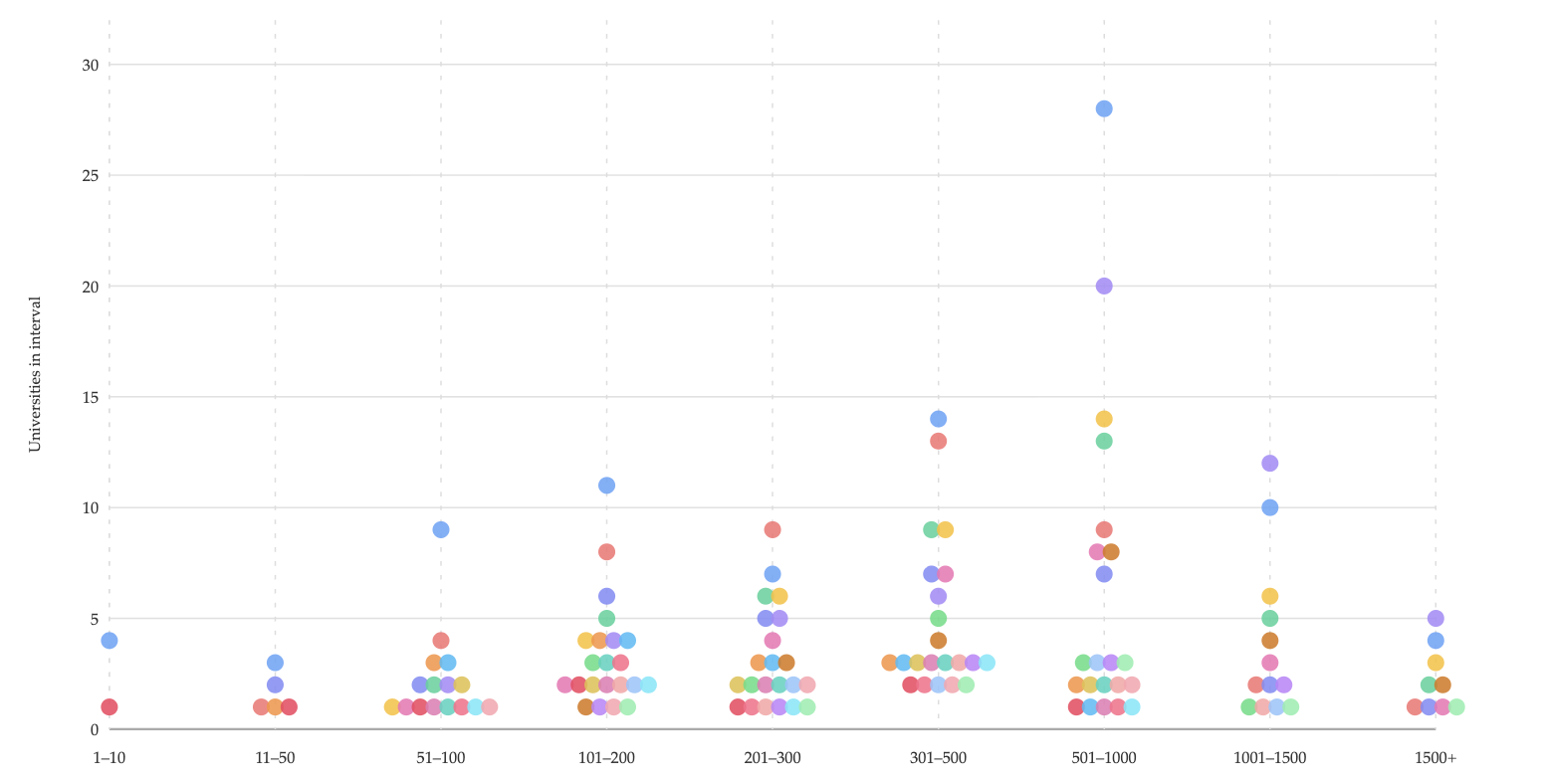
The chart above pulls together all 22 European countries that appear in the QS 2026 edition, published in June 2025, and maps their universities across nine rank bands — from the top 10 all the way past the 1,500 mark. Each dot represents one country’s count within a given band. The picture that emerges is not simply “UK good, everyone else worse.” It is considerably more textured than that.
Source: QS World University Rankings 2026, published by Quacquarelli Symonds (June 2025). The ranking covers over 1,500 institutions globally. Mid-band positions within each interval are estimates. Russia and Turkey are included under QS’s European regional scope.
European Universities per Rank Band
Each dot = one country · Y = universities within that interval · Click a country to highlight it
Based on QS World University Rankings 2026 (published June 2025). Mid-range positions are estimates. Country totals shown in parentheses. Russia & Turkey included per QS Europe regional scope.
The British exception
The United Kingdom’s position in these rankings borders on anomalous. With 90 universities in the QS 2026 list — far more than any other European country — the UK also claims 4 institutions in the global top 10, 7 in the top 50, and 16 in the top 100. No other European country comes close on any of those three counts. The nearest rival for top-100 placements is Germany, with 5.
What makes the UK’s profile unusual is not just its strength at the elite end but its sheer breadth. The distribution runs almost uniformly across every band, from the very top of the global table through to institutions ranked beyond 1,000. This is a system that produces both Oxford and Cambridge and a long tail of research-active universities that the QS methodology — which weights academic reputation surveys and citations per faculty heavily — tends to reward. Whether this reflects genuine educational quality or a structural advantage baked into a methodology conducted largely in English is, again, a fair question. But the scale of UK dominance is real regardless of how one interprets it.
The Germanic bloc: depth over headlines
Germany, Switzerland, and Austria form a coherent cluster worth examining together, though their profiles diverge sharply once you look past the surface.
Germany places 47 universities in the ranking — second only to the UK by volume — with a distribution that is notably concentrated in the middle tiers. Five German institutions appear in the top 100, but the peak of German density sits in the 301–500 and 101–200 bands. This reflects a university system that is deliberately non-hierarchical: Germany has no Oxbridge equivalent and has historically resisted the creation of one, prioritising broad access and consistent research quality across its institutions over the cultivation of a narrow elite. The QS methodology, which rewards name recognition and citation concentration, tends to flatten that kind of system.
Switzerland tells a different story entirely. With just nine ranked universities, it places three in the top 100 — a ratio of 33%, the highest efficiency rate of any country in this dataset by a significant margin. ETH Zurich and EPFL (École Polytechnique Fédérale de Lausanne) are genuine world-class research institutions by almost any measure, and Switzerland’s small, well-funded, internationally integrated system produces elite output that punches far above the country’s population or institutional count would suggest.
Austria, with nine universities like Switzerland, manages a single top-100 placement and is otherwise clustered in the 101–500 range. Solid, unremarkable in this context, and more representative of a mid-sized European university system than of the Swiss exception next door.
The Nordic countries: small, consistent, quietly excellent
Sweden, Denmark, Finland, and Norway together account for 38 ranked universities and present one of the most coherent regional profiles in the dataset. Every one of the four countries places at least one institution in the top 100 — Sweden places three — and none of them has universities appearing in the lowest bands. The distribution cuts off around the 501–1000 mark for all four, meaning the Nordic university systems produce no genuinely weak institutions by global standards, at least by QS’s measure.
Sweden leads the group, with three universities in the 51–100 band (no country places in the top 50 other than the UK, France, Germany, Switzerland, and the Netherlands), and a clean drop-off after 500. Denmark contributes a single top-100 institution alongside a handful spread through the 101–500 range. Finland and Norway mirror each other almost exactly: one entry in the top 100, modest numbers in the mid-tiers, nothing beyond 500.
What the Nordic profile suggests is that a combination of high public investment, strong international research integration, and relatively small but well-resourced university systems produces consistently high-quality institutions without the polarisation between elite and mass higher education that characterises larger systems.
Western Europe beyond the UK: France, the Netherlands, Belgium, Ireland
France places 32 universities in the ranking, with two in the top 50 and four in the top 100. The French system is unusual in the European context because its grandes écoles — institutions like Sciences Po, Polytechnique, or ENS — operate outside the traditional university structure and are not always captured or treated consistently in global rankings. What appears here represents only part of France’s higher education landscape, which partly explains why the country’s presence in the upper bands looks modest relative to its research output.
The Netherlands is the quiet overperformer of this group. Sixteen ranked universities, four in the top 100. That is a 25% elite conversion rate, second only to Switzerland. Dutch universities benefit from a research-intensive culture, strong English-language instruction, and a funding model that concentrates resources in a relatively small number of institutions. The result is a system that consistently punches above its weight.
Belgium and Ireland each contribute eleven universities to the ranking, both with two top-100 entries (Belgium) and one (Ireland). Both countries have small but internationally connected systems — Ireland in particular has benefited from its English-language advantage and the attraction of multinational research investment.
Southern Europe: volume, but limited elite presence
Italy and Spain are the Mediterranean’s two volume players, with 42 and 43 ranked institutions respectively. Both sit in a similar position: one or two universities in the 51–100 band, a concentration in the 101–500 range, and a long tail through the lower tiers. Neither country has a top-50 institution, and neither approaches the elite-band efficiency of Switzerland or the Netherlands.
Portugal has 14 ranked universities, none in the top 200. Its distribution peaks in the 301–500 and 501–1000 bands. Greek universities — 10 in total — follow a similar pattern, with their highest placements in the 101–200 range and a clear drop-off beyond that.
This is the Southern European pattern: large or medium-sized university systems that cover their populations adequately but have not yet produced or sustained institutions capable of competing consistently at the global elite level. Funding constraints, brain drain, and structural under-investment in research infrastructure all play a role. Italy and Spain have world-class individual researchers; the issue is systemic concentration of resources.
Eastern Europe and Russia: the bottom-heavy tail
Russia presents the most striking distributional anomaly in the dataset. With 54 ranked universities — more than France and second only to the UK — Russia’s profile is dramatically bottom-heavy. Only two Russian institutions appear in the top 100, and the bulk of the country’s presence is concentrated in the 501–1000 band (20 universities) and the 1001–1500 band (12 universities). More than 59% of Russia’s ranked universities sit below position 500. This reflects a system with enormous institutional breadth and genuine pockets of elite scientific output — particularly in engineering and natural sciences — but with severe inequality between its handful of flagship universities and the rest.
Poland is the most credible Eastern European performer, with 26 ranked universities and one in the top 100. Its distribution across the 201–500 range suggests a system improving steadily, if not yet producing consistent elite results. The Czech Republic, Hungary, and Romania all show similar patterns: small numbers of ranked institutions, none in the top 200, concentrated in the 301–1000 range. Romania’s profile extends into the 1500+ band, the only entry in this dataset to do so.
What the distribution reveals
Rankings are an imperfect instrument — they reward certain kinds of research output, certain languages, certain institutional sizes, and certain funding models in ways that systematically disadvantage others. But the distributional picture here goes beyond any single institution’s headline number. What the QS 2026 data shows for Europe is a continent that remains sharply divided between a small cluster of genuinely world-competitive university systems — the UK, Switzerland, the Netherlands, the Nordic countries, and to a lesser extent Germany and France — and a much larger group of systems that are solid, functional, and nationally important but have not yet broken through at the global level.
The most instructive data points are often not the top-10 placements but the ratios: Switzerland with nine universities and three in the top 100 is a more significant finding than the UK’s four in the top ten. The question for the next decade of European higher education policy is whether investment, coordination, and structural reform can narrow that gap — or whether the concentration of research prestige will continue to deepen along the same fault lines it has followed for the past half century.